
Innovation for a golden decade of 5G in Latin America
3 minutes read
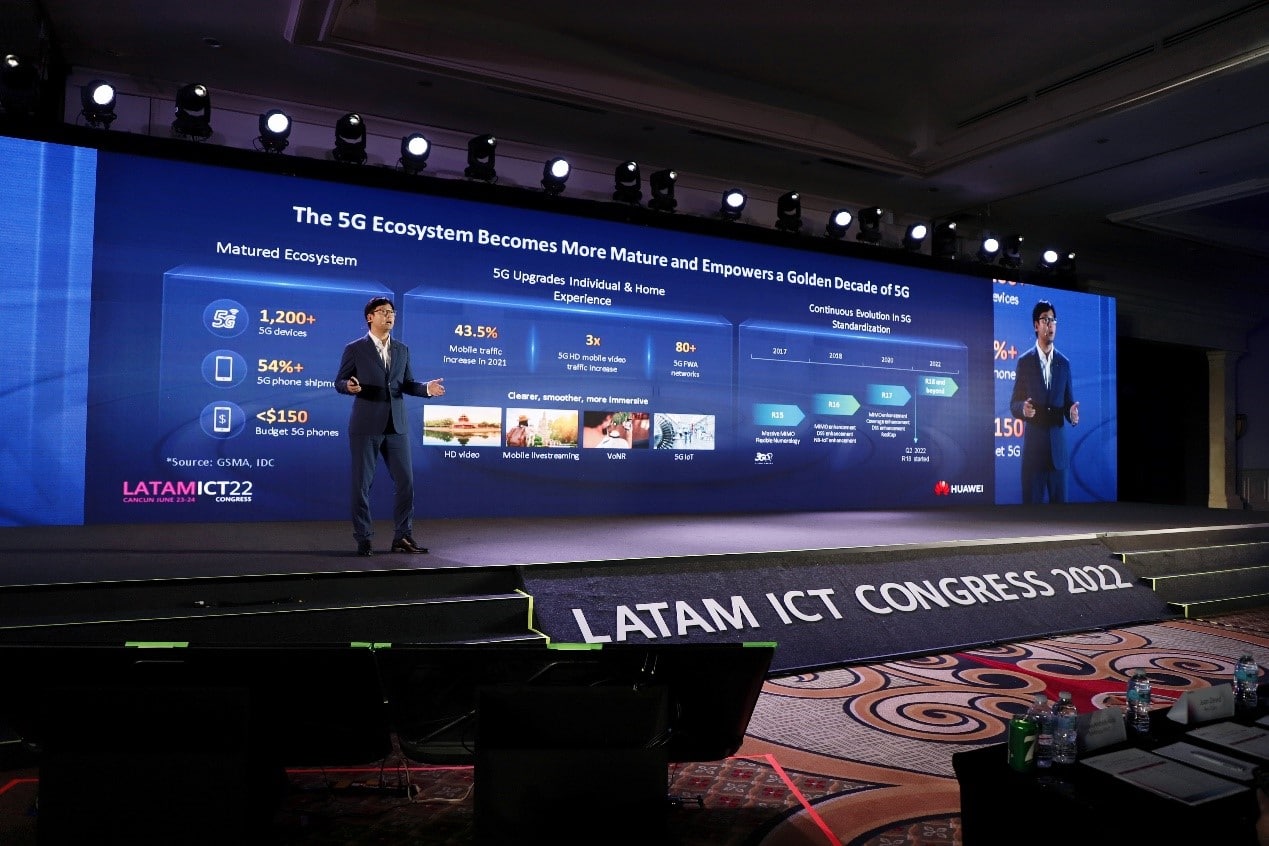
- At the LATAM ICT Congress 2022, Fang Xiang, Vice President of Huawei’s 5G Product Line, said Latin America is entering a golden decade for 5G development.
[Cancún, Mexico, June 2022] During the LATAM ICT Congress 2022, Fang Xiang, Vice President of Huawei’s 5G Product Line, gave a keynote speech entitled “Innovation for the Golden Decade of 5G in LATAM”. “Simplified, green 5G networks that deliver a cross-generation experience are essential to 5G commercial success. Huawei is committed to bringing multi-antenna and ultra-wideband technologies to every frequency band and every scenario through continuous 5G innovation, building a simplified, high-bandwidth target network with universal coverage, and so ushering in a golden decade of 5G in Latin America,” he said.
5G development is accelerating in Latin America. Over the last two years, 5G has been deployed commercially in countries such as Brazil, Mexico, Chile and Peru. While launching 5G packages and enjoying the digital dividends, operators are actively exploring new services for consumers, households and industries. Latin America is experiencing a golden age of rapid 5G development.
After more than two years of commercial 5G deployment, ultra-wideband and multi-antenna technologies stand out and have become the first choice of most operators. “Large-bandwidth, high-capacity TDD spectrum has weaker coverage than low-frequency bands, while FDD spectrum with wide coverage and fragmented frequency bands has low bandwidth,” said Fang. “Since the pace of 5G spectrum allocation varies by country, 5G network construction faces different challenges posed by the spectrum in different countries.
However, the goal of 5G network construction is the same worldwide: to deploy a network across multiple TDD and FDD bands. That is why we keep launching series of 5G products to help operators address their challenges and build simplified, green networks that deliver a cross-generation experience.”
Next-generation TDD ELAA-Massive MIMO enables optimal performance and energy efficiency
It has become an industry consensus that Massive MIMO is the right choice for deployment with large-bandwidth continuous TDD bands. Huawei’s latest MetaAAU features a new extremely large antenna array (ELAA) architecture that doubles the array scale and improves uplink and downlink coverage without increasing transmit power, greatly improving user experience. Tests show that, compared with conventional solutions, MetaAAUs improve cell uplink and downlink coverage by 30% and average cell-edge user experience by 25%. MetaAAUs allow base stations to achieve the same cell-edge coverage with lower transmit power, reducing energy consumption by approximately 30% compared with conventional AAUs.
“ELAA innovates in the new direction of improving coverage while reducing energy consumption. With its new architecture and algorithms, MetaAAU improves network performance and enables energy savings, helping operators build high-quality green 5G networks,” said Fang.
FDD ultra-wideband multi-antenna solution (4T-8T-Massive MIMO) maximises spectrum value
Based on the characteristics of FDD spectrum, multi-antenna and ultra-wideband technologies can be used to maximise spectrum value and improve 4G and 5G experience and capacity as existing spectrum evolves to 5G.
Huawei has launched the industry’s only highly integrated dual-band, ultra-wideband 4T4R RRU, supporting simplified deployment of 700–900 MHz/AWS + PCS multi-band networks. Full-band, full-RAT dynamic power sharing helps improve user experience by 20% and reduces energy consumption by 20%. Huawei has also launched the industry’s only ultra-wideband, ultra-high-power 8T8R RRU. Supporting AWS and PCS, and working with the first native 8T8R antenna based on the Hertz platform, it can significantly improve coverage and capacity.
In Latin America, where high-capacity antennas are restricted, Huawei will launch a new FDD BladeAAU next year. It integrates FDD Massive MIMO and full-band antennas to address deployment challenges.
For markets where new 5G bands have not been allocated, multi-antenna and ultra-wideband technologies can be used to reduce deployment costs for upgrading existing sites, improve 4G experience and capacity, and support evolution to 5G (including voice and IoT services).
Intelligent multi-band coordination solution (HashBAND) ensures optimal experience
For future 5G networks where multiple FDD and TDD bands coexist, Huawei has developed the multi-band coordination solution HashBAND. It enables intelligent coordination between different 5G bands to expand mid- and high-band 5G coverage while improving low-band cell-edge user experience, bringing multi-band value to customers’ networks and enabling a better 5G user experience.
Find out more about AF comunicación estrategica and its clients
More stories
- Social media intensifies body dysmorphic disorder; specialist calls for looking after mental health
- Mastitis, a condition that can become a medical emergency if it is not treated in time
- Hepatitis: the silent disease that can advance for years without symptoms
- IntraCare Center: raising awareness of sarcoma