More than 8,000 people trained by Hábitat Dominicana in risk mitigation and resilient construction
5 minutes read
- Habitat for Humanity Dominican Republic has trained more than 8,000 people in risk mitigation and resilient construction ahead of the hurricane season.
In the face of nature’s challenges, prevention, mitigation and response are key to reducing disaster risk. With this in mind, Habitat for Humanity Dominican Republic runs programmes to help families prepare for and recover from the impact of natural events.
The hurricane season, which began on 1 June and ends on 30 November, always brings threats. According to the Atlas of Housing Characteristics in the Dominican Republic, by 2020 more than 47.4% of homes in the country had zinc roofs; according to a Civil Defence report, there are around 1,006 areas vulnerable to the effects of weather events; and some 300,000 people live precariously along the banks of the Ozama River, according to a 2017 Oxfam report. For these people, being protected during the current hurricane season is difficult, especially when the zinc on their homes is in poor condition.
Hábitat Dominicana promotes resilient construction, as each year the hurricane season shows how important decent housing is for keeping people safe, which is why the organisation advocates implementing programmes aimed at risk reduction and response before and during disasters.
 It has different projects around the world that include climate change mitigation or adaptation, and it builds safe homes with guaranteed quality standards to minimise or eliminate risks from natural hazards.
In the region, within the international Habitat for Humanity network, in El Salvador the organisation has worked with partners to build bioclimatic homes that make the most of the climate and vegetation to achieve energy efficiency and resilience, while in Paraguay it helps neighbourhoods assess climate risks.
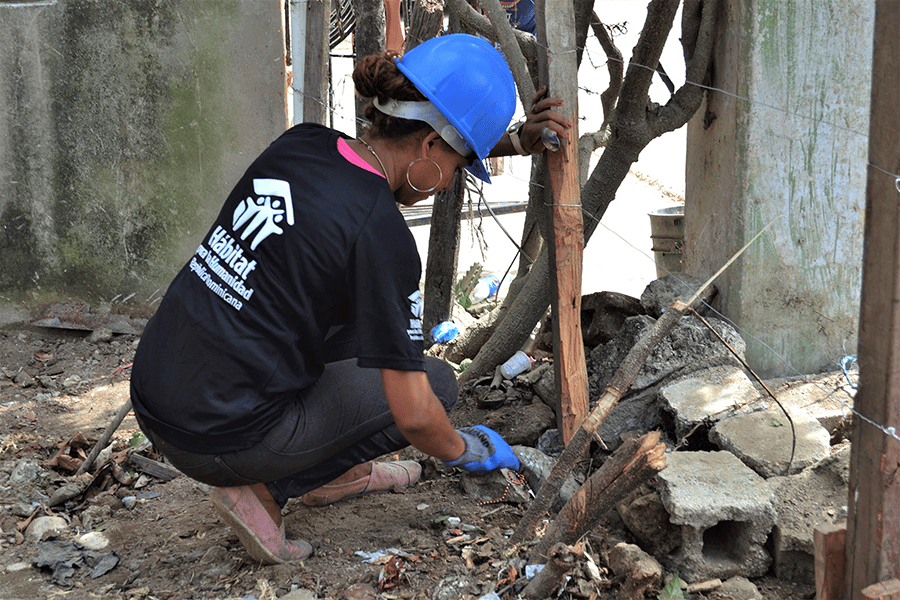
Meanwhile, at Hábitat Dominicana, more than 8,000 people have been trained directly and indirectly in risk management, running collective centres, hurricane-resistant housing, humanitarian protection, risk mapping, forming community networks, community construction brigades and rescue brigades for collapsed structures, resulting in a total of 19 communities having work plans aimed at mitigating risks and defining disaster response actions.
During hurricanes Irma and Maria, 810 emergency kits were distributed on the north coast, around 308 homes damaged by these storms were repaired as emergencies, 2 shelters meeting the standards required for refugees have been built, and every year the organisation trains families to prepare before the hurricane season.
Together with other organisations, Hábitat Dominicana was an important part of the Ponte Alerta Consortium, implementing the “Get Ready to Respond” project with Plan International, Ciudad Alternativa and OXFAM, funded by the European Union. The project began in 2020 and ended on 20 April 2022. Its aim was to strengthen the resilience and preparedness of urban communities to respond to disasters with a gender, protection and inclusion approach in the Dominican Republic, impacting the lives of 12,000 people with training on risk mitigation and promoting more resilient construction.
This project on mitigation before, during and after disasters was crucial for the urban communities where it was carried out, benefiting approximately 3,020 people with comprehensive hygiene kits adapted to COVID-19 and home protection.
During “Get Ready to Respond”, 5 community construction brigades were created, and the community was empowered to help repair ravines that were in unsuitable condition, posing a danger and affecting the health of the whole area
“As an organisation, our aim is to help strengthen and build resilience. Hábitat Dominicana’s commitment doesn’t stop. It’s important for people to understand the importance of a resilient home, and for families without a home to be able to build progressively and make improvements or repairs with the facilities we offer, so they have the peace of mind of a safe place, especially in times of weather vulnerability like this,” said engineer Francis Medina Taveras, construction and risk management coordinator at Hábitat Dominicana.
Families whose homes are built by Hábitat Dominicana are made aware of the importance of building a quality structure that lasts and is not affected by any natural phenomenon.
“We will continue with projects to build new homes, adapting to the times, incorporating new construction technologies and access to housing microfinance, so that more families have a better place to live,” said architect Betsaida Santana, programme manager at Hábitat Dominicana.
This year, the organisation will keep supporting families through training on important topics such as health, housing, healthy environments, economic recovery, and reducing and mitigating risks from vulnerabilities, among others.
Hábitat Dominicana continues working with all its partners towards a world where everyone is safe at home.
About the “Ponte Alerta: Get Ready to Respond” project
The Ponte Alerta Consortium’s “Get Ready to Respond” project brought together Plan International, Hábitat Dominicana, Ciudad Alternativa and OXFAM, and was funded by the European Union. The project aimed to strengthen the resilience and preparedness of urban communities to respond to disasters with a gender, protection and inclusion approach in the Dominican Republic.
About Habitat for Humanity Dominican Republic
Habitat for Humanity is a global non-profit, non-governmental organisation working to ensure everyone has a decent place to live, through programmes focused on housing microfinance, minimising risk and increasing disaster response.
Habitat for Humanity Dominican Republic empowers families to build strength, stability and self-reliance through shelter. Since it began its work in 1986, the organisation has delivered more than 37,000 housing solutions and impacted around 188,000 people.
Hábitat Dominicana contributes to the country by improving the living conditions of families affected by the qualitative and quantitative housing deficit. It does this by developing programmes that give low-income families access to housing microfinance with technical construction assistance, and by creating financial education programmes that support and help reduce the deficit. We empower through housing.
Find out more about AF comunicacion estrategica and its clients
More stories
- Public Health, the Dental Association and ADTS drive medical and dental tourism
- Alejandro Cambiaso presents the Dominican Republic’s health tourism success story in Guatemala and calls for a stronger regional vision for Latin America
- ADTS and AF Comunicación announce the 8th International Health and Wellness Tourism Congress 2027
- Internal Communication as a strategic tool for organisational management