Decent housing: its impact on residents’ health
3 minutes read
- The pandemic has made it clearer that decent housing, with drinking water, sanitation and energy, is fundamental to families’ health, says Habitat for Humanity Dominican Republic.
“At this time, the need for decent housing as a proper, fundamental shelter for families has become even clearer.” So says Cesarina Fabián, director of Habitat for Humanity Dominican Republic.
The United Nations Human Settlements Programme (UN-Habitat) considers that adequate housing must provide more than four walls and a roof.
It must also meet criteria such as availability of services, facilities and infrastructure, including drinking water, adequate sanitation and energy.
As well as security of tenure guaranteeing legal protection against forced eviction, harassment and other threats.
It must also offer affordability, habitability, accessibility, cultural adequacy and a location providing easy access to employment opportunities, health services, schools and other social services and facilities.
“A home can promote or limit the physical, mental and social health of its residents. Our top priority at Hábitat Dominicana is to protect the people and communities we serve, which is why we are strengthening our healthy housing and sanitation programmes.
Today more than ever, we must come together as a country and work to reduce the housing deficit so that most Dominicans have the opportunity to live in a home with the conditions needed to protect their health,” says Fabián.
Celso Marranzini, a direct collaborator of Hábitat Dominicana, invited reflection, saying that everything happening is yet another sign of the need for all men and women to have a decent place to live.
- “How can we ask people crammed into a tiny room to stay shut in?
- How can teenage pregnancies be prevented if parents or the mother’s partner live in overcrowded conditions with no privacy?
- In those conditions, how can we expect them to be healthy?
- How can we expect them to be able to study, however much effort is put into extended school days, breakfasts, snacks and meals?”
So says Marranzini in a public letter to President Danilo Medina.
Decent housing benefits residents’ health
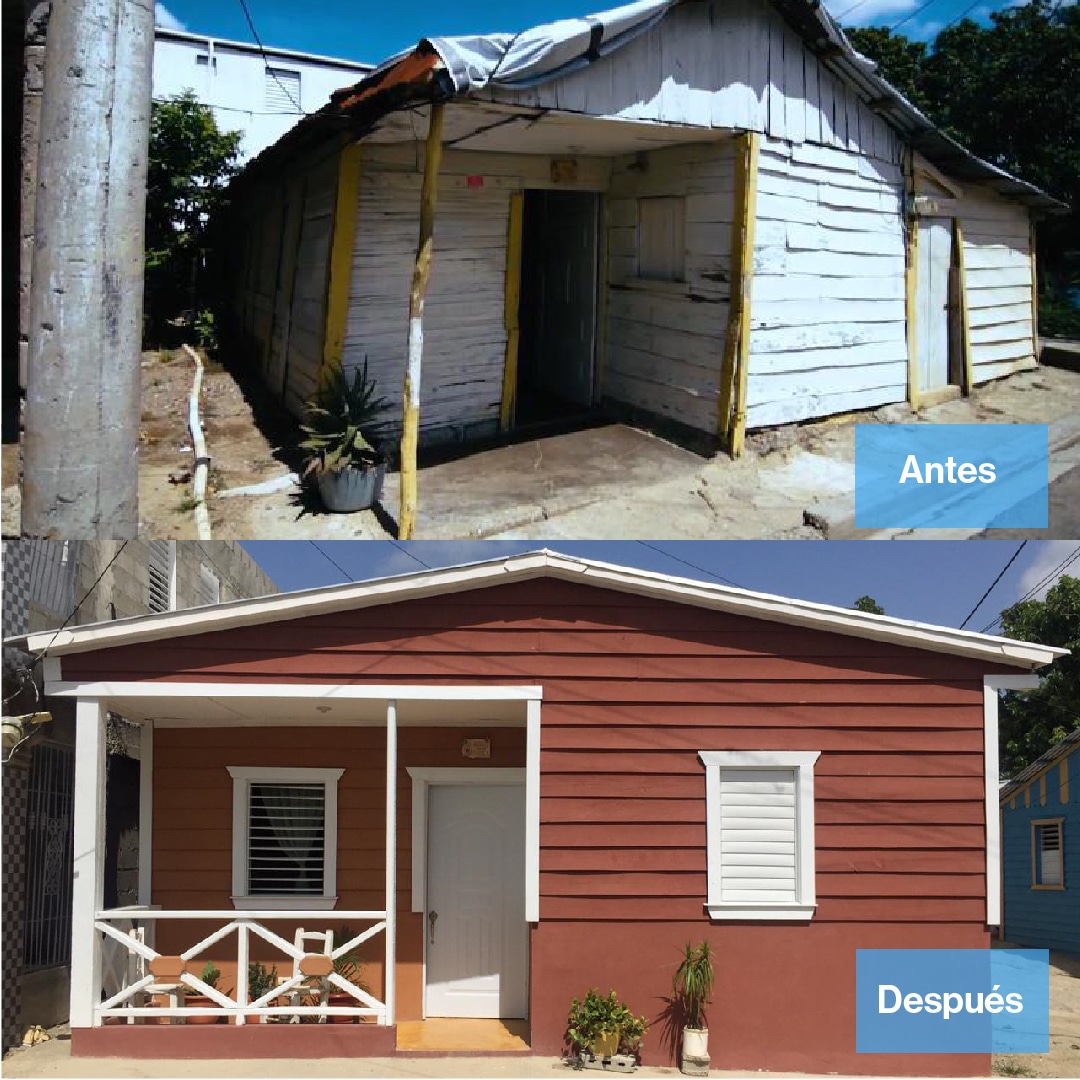
Decent housing. Habitat has worked in the country for 34 years to directly reduce the housing deficit, as shown by the more than 27,000 homes it has worked on over these years, benefiting 135,000 people.
Socially committed companies have joined Hábitat Dominicana’s work, experiencing the social, human and corporate satisfaction of helping build safe, decent homes that improve and impact the lives of low-income families in the Dominican Republic.
“We will keep working hard on our mission to achieve a world where everyone has a decent place to live. In our country specifically, we will do so with a stronger focus on healthy housing and financial education,” concludes Fabián.
For more information, visit the website or social media.
Habitat for Humanity Dominican Republic
A global non-profit, non-governmental organisation working to ensure people have a decent place to live, through programmes focused on housing microfinance, minimising risk and increasing disaster response.
With the vision of a world where everyone has a decent place to live, Habitat empowers Dominican families to build strength, stability and self-reliance through shelter.
To date, the organisation has delivered more than 27,000 housing solutions and impacted around 135,000 people.
It contributes to the country by improving the living conditions of families affected by the qualitative and quantitative housing deficit. It does this by developing programmes that give low-income families access to housing microfinance with technical construction assistance, and by creating financial education programmes that support and help reduce the deficit. we empower through housing.
More stories
- Multidisciplinary care: a centralised model that speeds up the early detection of cancer
- TransUnion expands Juan Camilo Badel’s remit to strengthen its growth strategy in Central America, the Dominican Republic and Mexico TSI
- Cleveland Clinic is the first centre in Ohio to perform a nipple-sparing robotic mastectomy
- DiDi boosts connections with the Metro and Cable Car of Santo Domingo