
The importance of caregivers: patient-centred, compassionate care
3 minutes read
- Chris Griffin, a Cleveland Clinic respiratory therapist, harnesses the calming power of horses to serve her patients and the community.
- Cooperation, compassion and innovation: the pillars of exceptional care at Cleveland Clinic.
Providing patient-centred care is the main goal of health centres today; however, this is not possible without the passion of their staff, as in the case of Chris Griffin, a Cleveland Clinic respiratory therapist who feels her job goes far beyond being an employee.
For Griffin, Cleveland Clinic’s culture means offering everyone the best care. It is important to comfort patients by treating them with dignity and respect. “I work with a team of very caring people, and I can’t count the times I’ve seen a nurse, a doctor or a respiratory therapist sitting by the bed holding a patient’s hand until their last breath.”
Griffin has been a respiratory therapist at Cleveland Clinic for more than thirty years, and for the last twenty she has worked in the Intensive Care Unit (ICU). She says she cannot imagine how patients feel when they depend on caregivers for everything, and explains that she focuses her work on this unit because she believes she can have a greater impact on patient outcomes.
The therapist also said that she has often taken ventilated patients outdoors, safely, to enjoy the fresh air.
She gives the example of a patient from the Dominican Republic who had been at Cleveland Clinic for six months after a heart attack, which left him with lung problems and tremors and unable to communicate verbally.
On one visit to this patient, his wife was showing him a video of his team-mates and photos of his horse. It was then that Griffin discovered the patient was a professional polo player, and she noticed that he had no tremors while he was watching the pictures and videos.
By chance, Griffin also has horses, and over the following days she talked to him and showed him and his wife photos of her horses, and each time his tremors stopped.
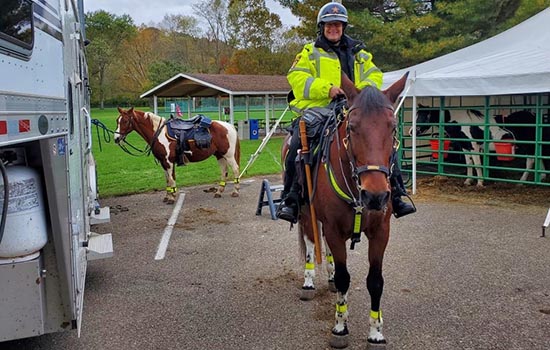
The therapist says horses are healing and believes animals choose us. “I understood how much this patient missed his horse, just as all hospitalised patients miss their dogs and cats. That’s when I had the idea of bringing Zip, one of my horses, to see the patient,” she recounts, visibly moved.
A horse… in the hospital?
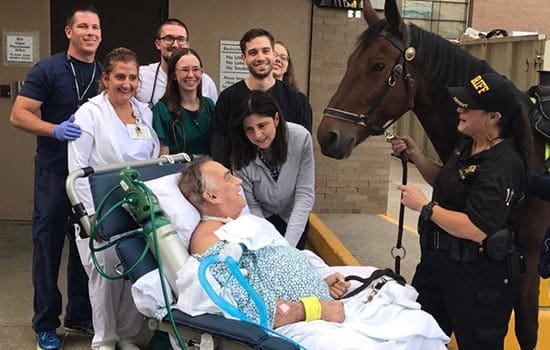
Griffin presented her idea to the medical staff, who agreed to the plan. The unit’s nurse manager took the initiative and organised the visit in just two days. The patient’s wife and friends, a respiratory therapist, nurses, a nurse manager, a physiotherapist and other caregivers were also involved and put their all into the surprise visit.
When the horse was at the back of the Cleveland Clinic campus, they took the patient out to the courtyard. At first he felt overwhelmed, as it was the first time in eight months he had left his room, but everything changed when he saw Zip in front of him. He reached out his hand, and the horse rested its head in his lap for about 45 minutes, during which he had no tremors, the therapist recalls.
“A couple of days later I popped my head into the patient’s room. He mouthed ‘thank you’. It was truly the best thank-you I’ve ever received. I forget how blessed I am to have horses, but when I see someone smile, like this patient stroking Zip, I remember how special horses really are,” said the respiratory rehabilitation specialist.
At Cleveland Clinic, they care not only about health conditions but also about the person. Every year they treat thousands of patients from around the world who choose Cleveland Clinic for exceptional care based on the principles of cooperation, compassion and innovation.
More stories
- Multidisciplinary care: a centralised model that speeds up the early detection of cancer
- TransUnion expands Juan Camilo Badel’s remit to strengthen its growth strategy in Central America, the Dominican Republic and Mexico TSI
- Cleveland Clinic is the first centre in Ohio to perform a nipple-sparing robotic mastectomy
- DiDi boosts connections with the Metro and Cable Car of Santo Domingo