
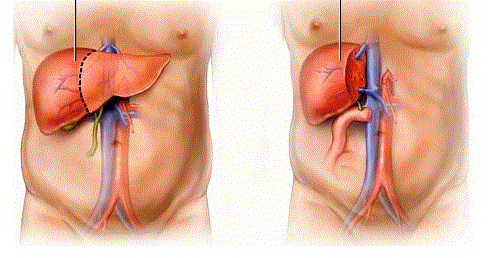
Living donor transplants ease the waiting list for liver patients
3 minutes read
- Living donor liver transplants help reduce the waiting list for liver patients, explains Dr. Teresa Diago Uso of Cleveland Clinic.
At Cleveland Clinic in Ohio, around 8,000 liver transplants are currently performed each year. The number of candidates added to the liver transplant waiting list rose to 11,340 in 2016, compared with 10,636 in 2015 and 10,646 in 2014.
“That is why living donor transplants are so important for reducing this waiting list,” said Dr. Teresa Diago Uso, director of abdominal transplantation and the hepatobiliary fellowship at Cleveland Clinic and quality director for the liver transplant and hepatobiliary surgery sections, during the webinar “Liver Transplantation at Cleveland Clinic”. She stressed “that the volume of patients for liver transplantation is increasing, with more and more patients being referred and waiting”.
Always seeking to be at the forefront, Cleveland Clinic has performed combined transplants since 2006, such as liver and lung transplants and liver and heart transplants. Liver transplants are also carried out together with open-heart surgery.
The doctor also highlighted that “for transplants to work well, it is crucial to synchronise the participation and coordination of all programmes, such as joint selection committee meetings, quarterly transplant quality meetings, transplant council meetings, monthly data and quality reviews, clinical managers’ meetings, transplant centre grand rounds, fortnightly leadership meetings and education conferences”.
She also explained that liver transplantation should be reserved for patients who have exhausted standard medical and surgical therapies. The procedure is the treatment of choice for patients experiencing life-threatening complications of end-stage liver disease.
“Cleveland Clinic has protocols for transplanting patients with cholangiocarcinoma and colorectal liver metastases. Few centres in the United States follow these protocols. “Also neuroendocrine tumours and epithelioid haemangioendothelioma, which is quite a rare tumour; we have many cases of it,” said the specialist.
Dr. Alejandro Pita, a clinical transplant fellow at Cleveland Clinic Ohio who also took part in the seminar, explained that the post-operative phase is extremely important given the level of intensive follow-up these patients require and the complications that may arise at this stage.
“After surgery, the patient goes to the intensive care unit, where they are carefully monitored to detect any eventuality. Once they no longer need intensive care, they are moved to a regular ward, where they stay for about the first two or three days after surgery if there are no complications, and of course long-term follow-up is key.”
Finally, Dr. Teresa Diago Uso said: “It’s important to know that in the United States the living donor doesn’t have to be a family member, as there are anonymous donors; the patient can be referred and we can find a donor at Cleveland Clinic. We prefer living donors, even though both surgeries are more demanding.”
About Cleveland Clinic
Cleveland Clinic is a nonprofit multispecialty academic medical centre that integrates clinical and hospital care with research and education. Located in Cleveland, Ohio, it was founded in 1921 by four renowned physicians with a vision of providing outstanding patient care based on the principles of cooperation, compassion and innovation.
More stories
- Multidisciplinary care: a centralised model that speeds up the early detection of cancer
- TransUnion expands Juan Camilo Badel’s remit to strengthen its growth strategy in Central America, the Dominican Republic and Mexico TSI
- Cleveland Clinic is the first centre in Ohio to perform a nipple-sparing robotic mastectomy
- DiDi boosts connections with the Metro and Cable Car of Santo Domingo