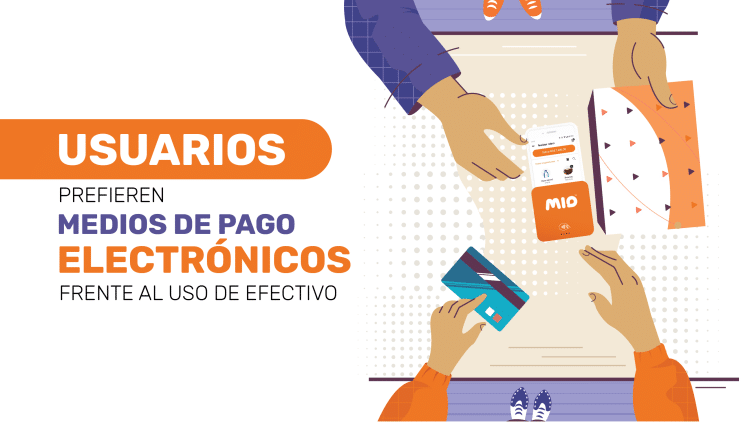
Users prefer electronic payment methods to cash
3 minutes read
- The trend towards digital channels has grown, as has the trust of customers and businesses, which are increasingly diversifying how they charge for their products and services.
Santo Domingo, March 2022.- Following the economic effects of the COVID-19 pandemic, Dominicans have increasingly turned to digital payment methods as an alternative to cash when buying goods and services, with card payments carrying the most weight.
The evolution of digital payment channels is down to technological advances that have given rise to new platforms making it easier for players in the business world to interact, through tools such as mobile phones, tablets and computers that put fast internet access at their fingertips.

Collecting payments from your phone with a 100% native app that keeps a record of sales marks innovation in the market. People can combine in-person contact, using card readers, with remote payments using digital payment links, explained Maximiliano Barr, co-founder and CCO of MIO.
Barr, a business management specialist, said the way of doing business has changed, as small entrepreneurs can now use platforms designed for their type of business, making it easier to keep track of their sales and understand their customers’ spending patterns.
He explained that MIO is a solution that works hand in hand with the traditional financial sector to drive the diversification of payment methods, economic growth and the social development of businesses and independent professionals, promoting financial inclusion.
The rise of electronic transactions
Payment systems have evolved alongside technological advances. In January 2021, the Monetary Board approved an amendment to the Payment Systems Regulation creating the conditions for the financial sector and the productive economy to diversify electronic payment transactions.
In this regard, the Central Bank reported that the daily average of peso transactions through the Real-Time Gross Settlement System (LBTR) rose from RD$50,319 million in March 2009 to RD$177,562 million in the same month of 2021.[i]
As of February 2021, bank customers carried out 94.3% of their transactions with payment instruments through electronic payments and only 5.7% with cheques, reinforcing the trend towards greater use of electronic payment instruments and fewer cheques.
The recorded statistics show that the trend towards digital channels has grown over time, as has the trust of customers and businesses, which are increasingly diversifying how they charge for their services and products.
MIO’s co-founder and CCO also noted that between February 2009 and February 2021, the number of debit, credit and prepaid cards in circulation rose by 70.9%, from 4,553,833 cards to 7,781,824.[ii]
He added that “the preference for electronic channels, and the greater availability of services through them, is evident in the increase in access via computers and mobile devices, from 1,191,852 in February 2014 to 5,486,226 in January 2022”.[iii]
“At MIO we want to empower Dominicans and help people and businesses grow and prosper,” said the executive.

About MIO
A digital financial management platform that lets you accept card payments from a mobile phone or smartphone. It helps people and businesses grow by giving them simple tools so they can live to the full. MIO believes that democratising sound personal and business financial management is possible through digital platforms and practices that enable financial inclusion.
[i] Central Bank of the Dominican Republic (bancentral.gov.do)
[ii] Central Bank of the Dominican Republic (bancentral.gov.do)
[iii] Central Bank of the Dominican Republic (bancentral.gov.do)
Find out more about AF comunicación estrategica and its clients
More stories
- Multidisciplinary care: a centralised model that speeds up the early detection of cancer
- TransUnion expands Juan Camilo Badel’s remit to strengthen its growth strategy in Central America, the Dominican Republic and Mexico TSI
- Cleveland Clinic is the first centre in Ohio to perform a nipple-sparing robotic mastectomy
- DiDi boosts connections with the Metro and Cable Car of Santo Domingo